 Bahrain, Saudi Arabia





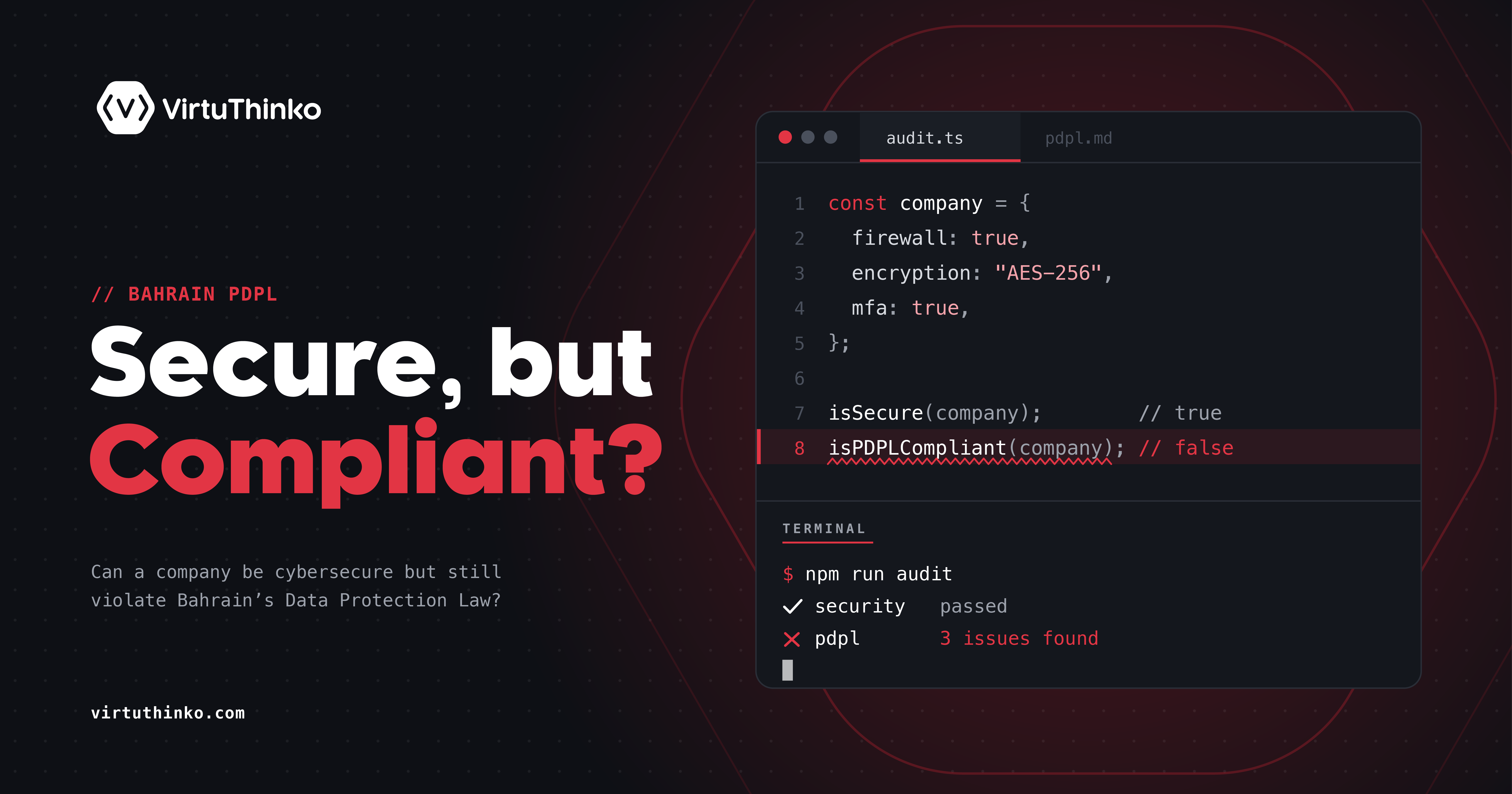
Why authentication, encryption, and secure infrastructure are only part of protecting personal data.
You have implemented HTTPS, encrypted your database, configured role based access control, and secured your APIs.
Your application has passed its security tests.
But here's a question:
Are you sure your application handles personal data legally?
For developers building applications in Bahrain, this distinction is becoming increasingly important.
Bahrain's Personal Data Protection Law (PDPL), established under Law No. 30 of 2018, introduces obligations that go beyond traditional application security.
An application can be technically secure while its data processing practices still raise regulatory compliance concerns.
Let's look at why.
Security Does Not Automatically Mean Privacy Compliance
Developers typically approach data protection from a technical perspective.
We implement:
- Encryption at rest and in transit
- Authentication and authorization
- Secure API communication
- Database access controls
- Logging and monitoring
- Vulnerability management
These measures are essential, but they primarily address how information is protected against unauthorized access and security threats.
Privacy regulations introduce additional questions.
- Why are we collecting this information?
- Do we need every field in this database?
- How long should we retain it?
- Who are we sharing it with?
- What happens when the information is no longer needed?
These questions relate to data governance and lawful processing, areas that cannot be addressed through technical security controls alone.
Example 1: Collecting More Data Than Necessary
Consider a simple user registration form.
{
  "full_name": "Ahmed",
  "email": "[email protected]",
  "phone": "+973XXXXXXXX",
  "date_of_birth": "1995-01-01",
  "national_id": "XXXXXXXXX"
}
Suppose the application only requires an email address and password to provide its intended service.
Why collect a national ID number or date of birth?
Even if these fields are encrypted and securely stored, collecting unnecessary personal information can introduce privacy compliance risks.
One principle developers should consider is data minimization: limiting collection to information that is necessary for a legitimate, defined purpose.
A more appropriate registration structure might be:
{
  "email": "[email protected]",
  "password": "securely_processed_password"
}
The actual fields required will depend on the application's purpose and applicable legal requirements.
The lesson is simple: every additional personal data field creates another responsibility.
Example 2: Keeping Personal Data Forever
Imagine your application stores user activity logs.
CREATE TABLE user_activity (
    id BIGINT PRIMARY KEY,
    user_id BIGINT,
    ip_address VARCHAR(45),
    activity TEXT,
    created_at TIMESTAMP
);
The application continuously collects information, but there is no retention policy.
After five years, the database still contains historical records that may no longer serve their original purpose.
This creates several concerns:
- The organization may retain personal information longer than justified.
- Historical data increases the potential impact of a security incident.
- Developers may struggle to locate and manage personal information across systems.
- The organization may be unable to demonstrate appropriate retention practices.
A practical engineering approach is to define retention requirements during system design.
For example:
def process_expired_records(records, retention_policy):
    for record in records:
        if retention_policy.is_expired(record):
            retention_policy.apply_disposition(record)
The appropriate retention period and disposition method should be established according to the data's purpose, applicable legal obligations, and organizational policies.
Data retention should be a documented design decision, not an accidental consequence of database architecture.
Example 3: Sharing Data With Third Party Services
Modern applications rarely operate independently.
They integrate with analytics platforms, cloud providers, customer relationship management systems, payment gateways, and AI services.
Consider an application sending customer information to an external API.
await fetch("https://api.example.com/analyze", {
  method: "POST",
  headers: {
    "Content-Type": "application/json"
  },
  body: JSON.stringify({
    customerName: user.name,
    customerEmail: user.email,
    conversation: user.messages
  })
});
The API request may be encrypted and properly authenticated.
However, additional questions remain:
- Is the external provider authorized to receive this information?
- Is sending identifiable customer data necessary?
- Where will the provider process and store the information?
- Are appropriate contractual and regulatory safeguards in place?
- Does the transfer involve another jurisdiction?
Depending on the circumstances, Bahrain's PDPL requirements concerning processing and international transfers may become relevant.
A safer development practice is to evaluate external data flows before integrating third party services.
For example, developers could remove unnecessary identifiers before transmitting information where the use case permits.
Who Is Responsible for Data Protection Compliance?
This raises an interesting challenge.
Developers understand the systems.
Security teams understand technical risks.
Legal and compliance teams understand regulatory obligations.
But who ensures these responsibilities are coordinated?
Bahrain's PDPL recognizes a role known as the Data Protection Guardian.
Under Article 10 of the law, Data Protection Guardians perform functions that include assisting organizations with their data protection obligations, monitoring compliance, and coordinating with the relevant regulatory authority.
The regulatory framework recognizes both internal and external guardians.
An External Data Protection Guardian is a registered individual or legal entity that may be appointed to perform these oversight responsibilities.
While appointing a guardian is not automatically mandatory for every business, certain categories of organizations may be required to appoint one under the applicable regulatory framework.
This role connects regulatory requirements with the organizational processes and technical systems used to handle personal data.
What Developers Can Do Today
You don't need to become a legal expert to start building applications with better privacy practices.
A few engineering decisions can make a meaningful difference.
1. Map your data flows
Understand where personal information enters your application, where it is stored, which services receive it, and how it is eventually removed.
2. Minimize collection
Avoid collecting personal information simply because it might be useful someday.
3. Define retention requirements
Work with the relevant business and compliance stakeholders to establish retention and deletion policies.
4. Review third party integrations
Know what personal information leaves your infrastructure and which service providers process it.
5. Design for privacy from the beginning
Consider data protection requirements during architecture and development rather than waiting until deployment.
6. Involve the right stakeholders
Privacy requirements should be reviewed collaboratively by engineering, security, legal, and compliance teams.
These practices can help reduce privacy risks, but they do not independently establish legal compliance.
The Bigger Picture
Privacy engineering is becoming an important part of modern software development.
As applications increasingly depend on cloud infrastructure, AI integrations, and interconnected services, developers influence how personal information is processed throughout its lifecycle.
Understanding data protection requirements is therefore becoming just as relevant to software architecture as authentication, encryption, and access management.
In Bahrain, this also creates a growing need for coordination between engineering teams and professionals responsible for data protection oversight.
In August 2026, Bahrain based cybersecurity company VirtuThinko W.L.L. received official registration as an External Data Protection Guardian from the Kingdom's Personal Data Protection Authority.
The registration enables VirtuThinko to undertake this role for organizations requiring external data protection oversight.
For developers and technical teams, the important takeaway is that secure software development and privacy compliance should not operate independently.
A secure application protects data from unauthorized access. A privacy conscious application also considers whether that data should be collected, processed, shared, or retained in the first place.
Both matter.
References
- Bahrain Personal Data Protection Law, Law No. 30 of 2018
- Order No. 46 of 2022 Regarding Data Protection Guardians
- Personal Data Protection Authority, Kingdom of Bahrain
Technical examples are illustrative and do not constitute legal advice.